11.2025
Anh Mã et la morsure du serpent
Open studio
VAC
Hanoi, VN.
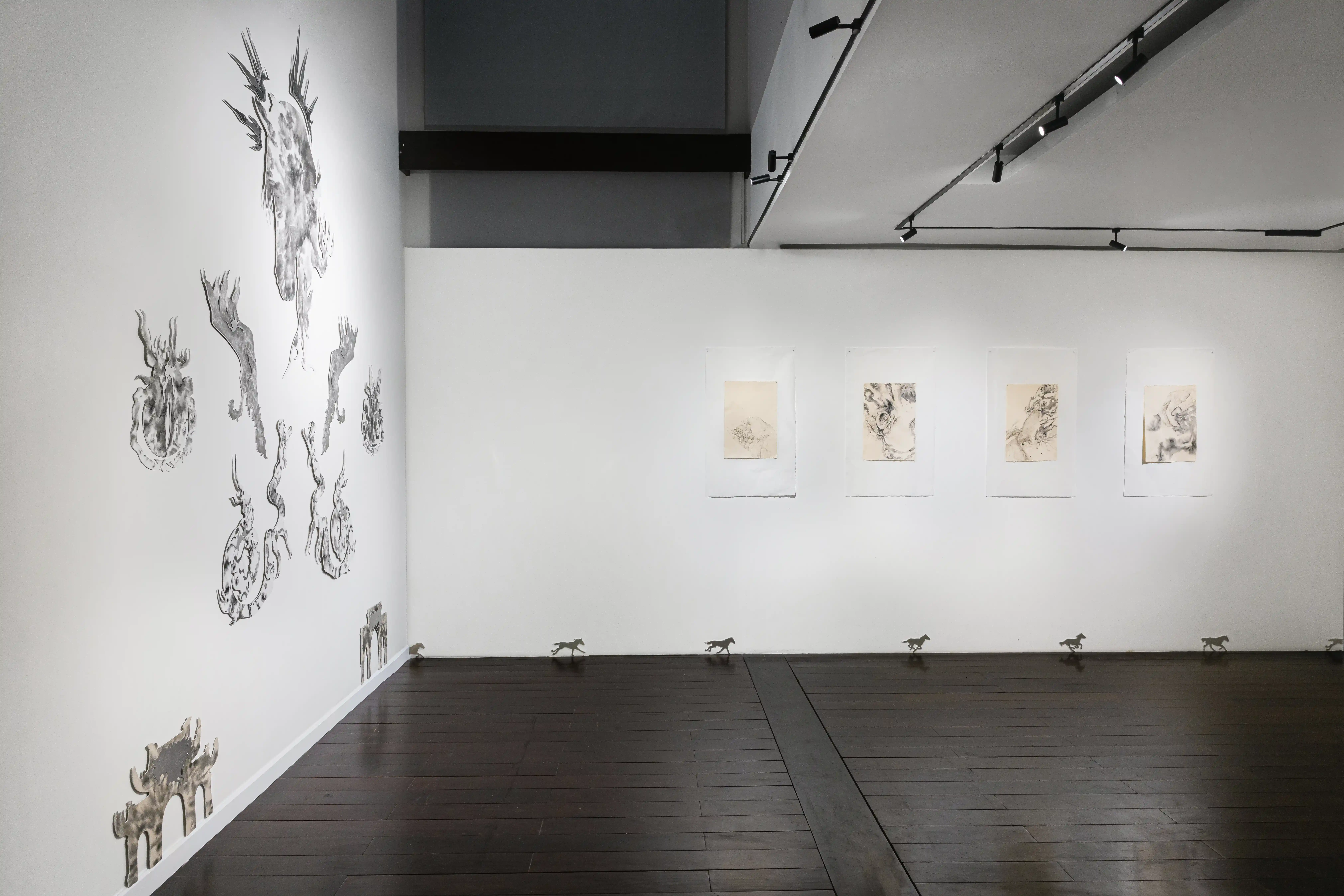
vue d'exposition
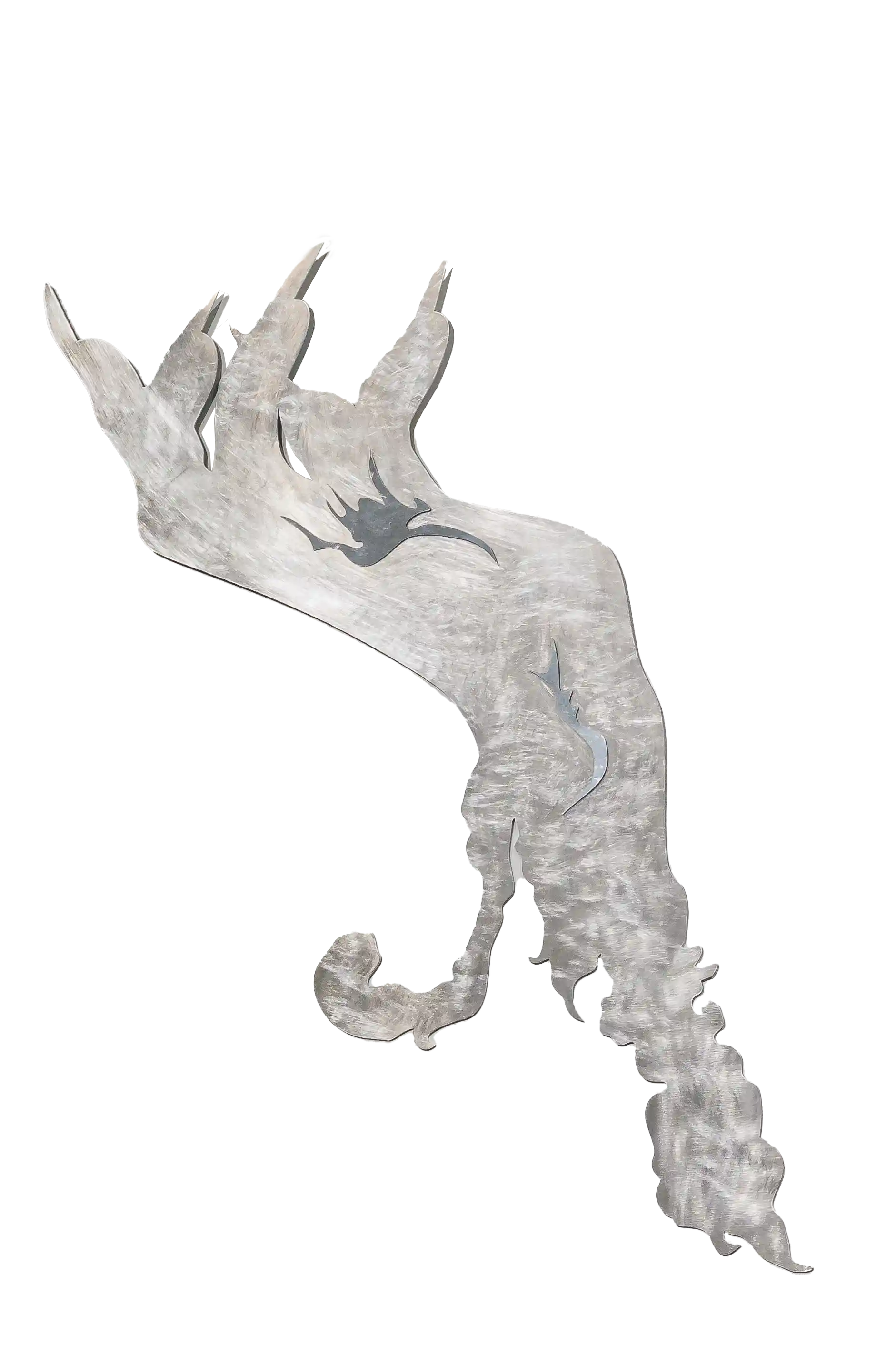
formes en fer, encre et eau sur papier Dó et Xuan
metal shape, ink and water on Dó and Xuan paper
vue d'exposition
16 dessins
dessin mural
encre et eau
exhibition view
6 drawings
fresco
water and ink
Certaines histoires se cachent dans les plis de l’Histoire. Elles subsistent par fragments dans la mémoire de quelques-uns, puis disparaissent avec eux dans le roulis inexorable du temps. Tout finit par fuir sur la bande. Ce projet prend sa source dans l’une de ces histoires des interstices.
Mohamed Ben Aomar Larach, syndicaliste marocain issu des milieux anticolonialistes, rejoignit le Vietnam à la fin des années 1940 dans le cadre de solidarités transnationales entre mouvements de libération. Il y fut accueilli par le Viet Minh, où il mena un travail de ralliement auprès des soldats nord-africains enrôlés par l’armée coloniale française, avant d’y devenir général.
On raconte que Ho Chi Minh lui aurait donné le surnom d’Anh Mã, signifiant « Grand Frère Cheval ». Un nom à la fois fraternel et totémique, où l’homme et l’animal se rejoignent dans une même figure de passage.
L’existence d’Anh Mã surgit par bribes pour qui s’y intéresse : quelques récits oraux, des fragments de mémoire, et un ouvrage mené par Abdallah Saaf 1 , qui reconstitue, au fil d’années de recherche, la trajectoire singulière de Mohamed Ben Aomar Larach. Ce travail d’investigation a nourri ma propre exploration tout en m’ouvrant vers un monde d’images et de symboles.
En abordant cette trajectoire comme un espace interstitiel entre mémoire et effacement, Anh Mã et la morsure du serpent interroge la manière dont la fiction peut agir comme un lieu de réapparition, où l’histoire et l’imaginaire s’entrelacent pour redonner présence à ce qui a été effacé. Les formes produites dans l’exposition deviennent alors le lieu d’une mythogenèse en acte. En d’autres termes l’émergence visible d’un mythe en formation, où la matière, le dessin et le symbole réactivent une mémoire enfouie. À partir de cette figure, j’ai cherché à déployer un récit fait de correspondances et d’échos. Le cheval, porteur du nom et du mythe, en est la matrice : il incarne les forces du déplacement, de la traversée et du sacré.
Dans les récits spirituels et mythiques du Vietnam comme du Maroc, le cheval surgit comme un archétype transversal : un être liminal, messager entre les vivants et les esprits, porteur du souffle et du passage. Au Vietnam, Bạch Mã, le Cheval blanc gardien de Thăng Long, révèle le lieu sacré ; au Maroc, il trouve notamment son écho dans la figure du Bouraq, créature hybride et lumineuse qui symbolise le voyage entre les mondes.
À travers ces résonances, Anh Mã se charge d’une puissance symbolique élargie : celle d’un corps de passage, traversé par la mémoire, la croyance et la transformation.
En miroir, le serpent rampe, mue, mort, il agit comme principe d’altération et de mutation. Là où le cheval porte la mémoire, le serpent introduit le mouvement du devenir. Ensemble, ils incarnent deux temporalités du mythe : l’élan et la métamorphose, la révélation et la transfiguration.
La morsure du serpent ouvre dans le corps du cheval une faille, un passage : de l’homme au cheval, de l’histoire au mythe.
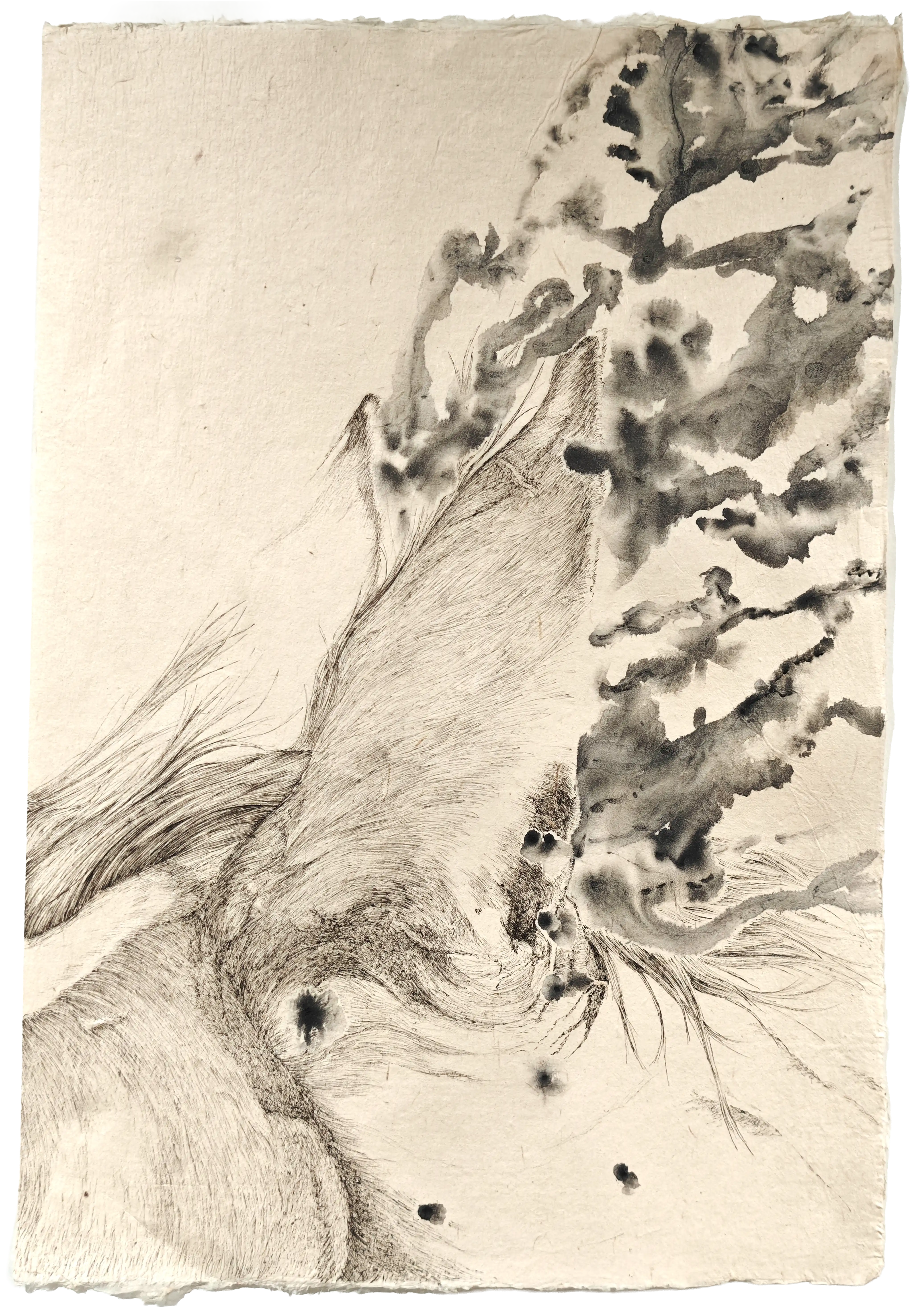
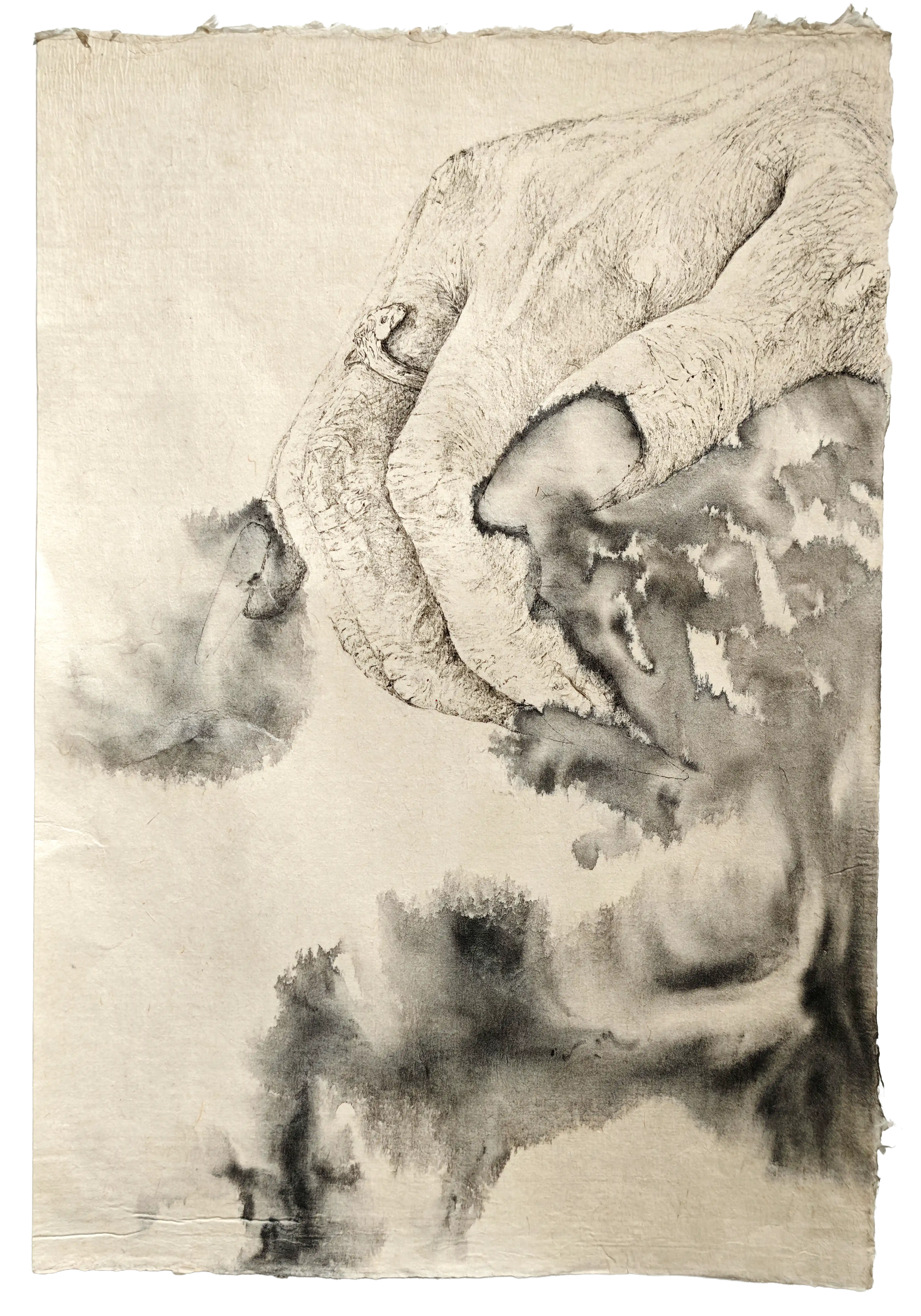
Cette tension trouve sa traduction dans la matérialité du travail. Le dessin y devient un champ d’exploration, un mode d’approche de ce qui échappe à la parole historique. J’utilise le papier Dó et Xuan, dont la fragilité fibreuse rend visible le temps du geste ; j’y fais dialoguer l’encre et le métal, la suspension et le poids, la transparence et l’opacité. Chaque matériau contient sa mémoire propre : le papier, celle du végétal et du souffle ; le métal, celle de la structure et de la résistance. Entre eux s’installe un équilibre instable, un espace où la gravité se négocie. Le dessin n’est plus seulement représentation : il devient un acte de pensée, une méthode d’enquête qui matérialise l’invisible, une manière de donner forme à ce qui demeure en creux, entre apparition et disparition.
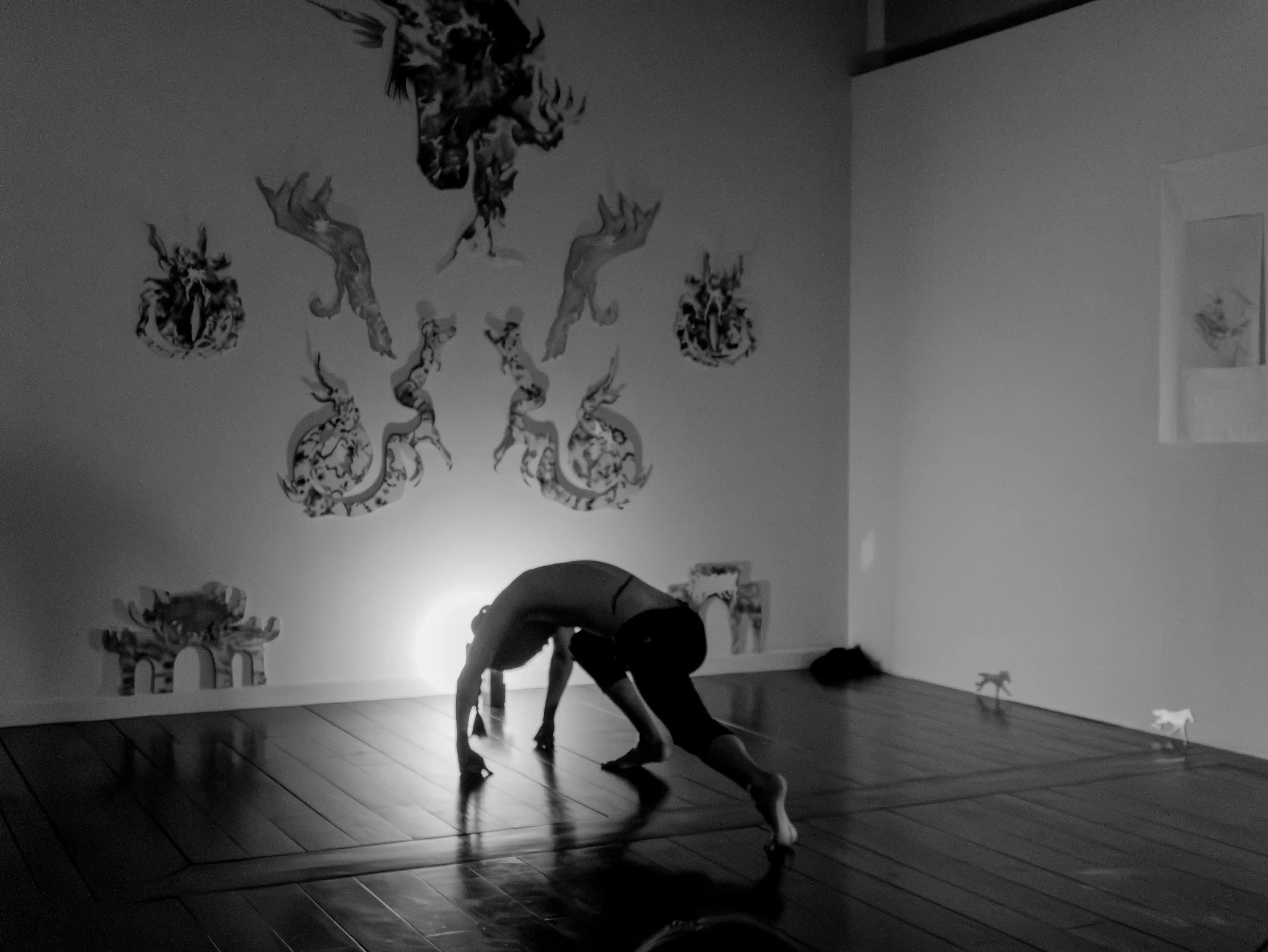
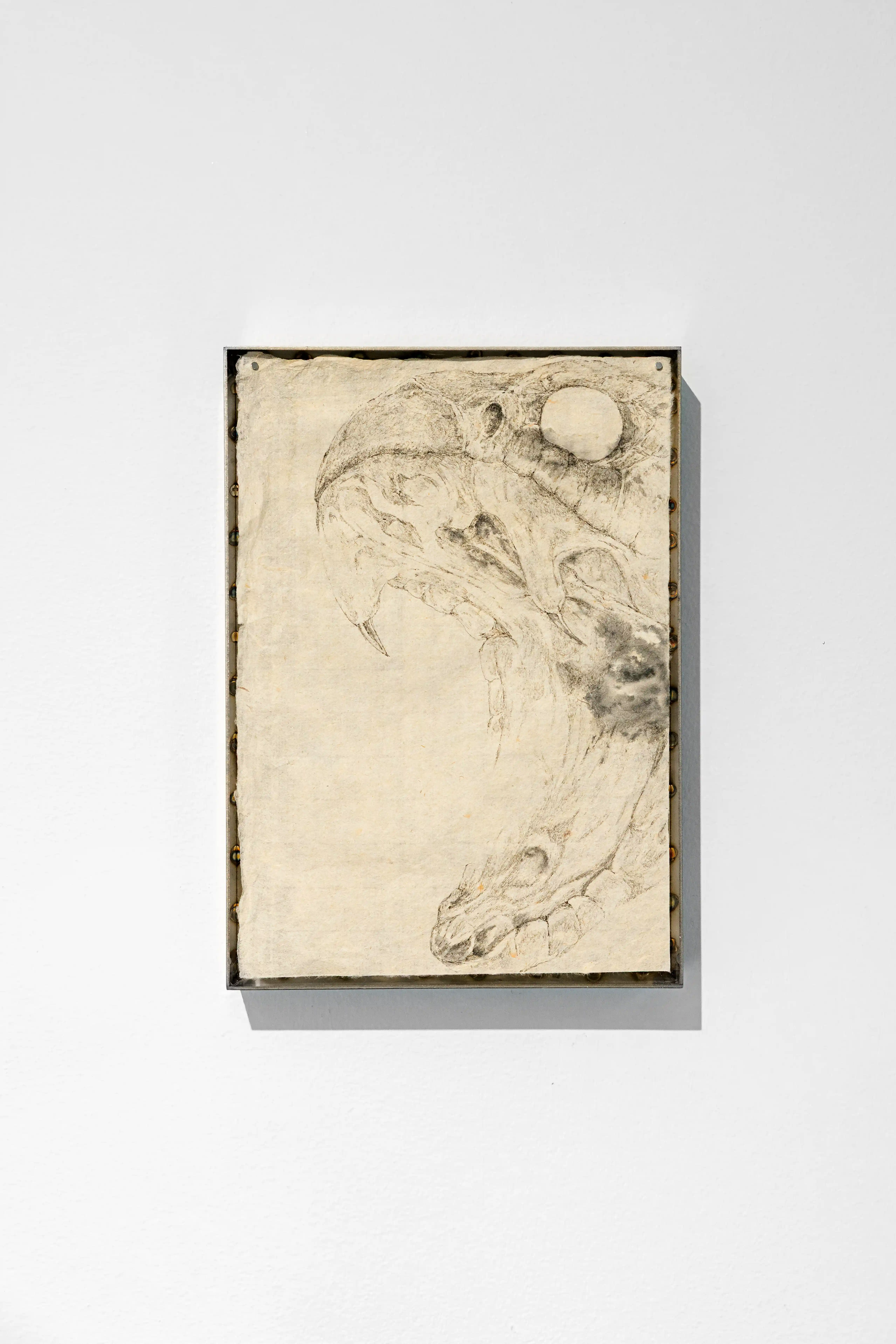
L’exposition présentée à VAC se déploie en deux espaces distincts mais liés. Dans la première salle, douze formes découpés en métal et sept dessins à l’encre flottants composent un ensemble symbolique. Au centre, un cheval couronné de métal fait face à deux mains inversées, tandis que deux serpents jumeaux semblent s’élever vers lui. Sous cette scène, deux portes : l’une inspirée de la Porte du Maroc érigée à Ba Vì par les soldats marocains ralliés au Viet Minh dans les années 1950 et l’autre de la Porte du Vietnam, construite des décennies plus tard à Douar Sfari, près de Kénitra, par les familles issues de ces unions mixtes se font face comme deux seuils jumeaux.Ces architectures, séparées par le temps et réunies par la mémoire, prolongent dans la matière le mouvement des corps, des histoires et des appartenances. Chacune est accompagnée d’un poème gravé (en vietnamien et en français). En s’éloignant, la composition révèle la silhouette d’un serpent, gueule ouverte, comme une apparition dans l’apparition.
Au sol, une frise de chevaux découpés dans l’aluminium relie les différents ensembles, accompagnée d’une série de sept dessins sur papier.
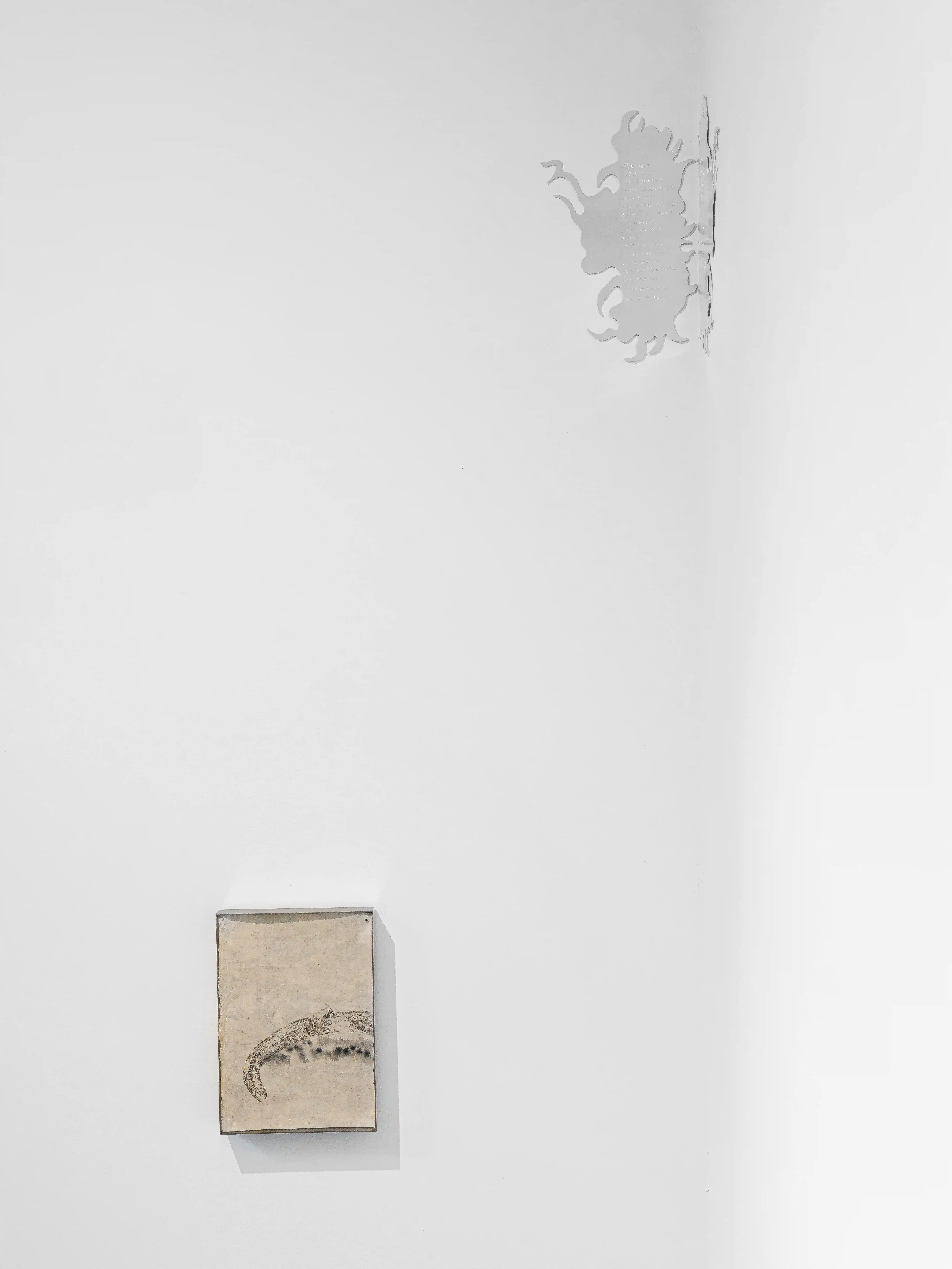
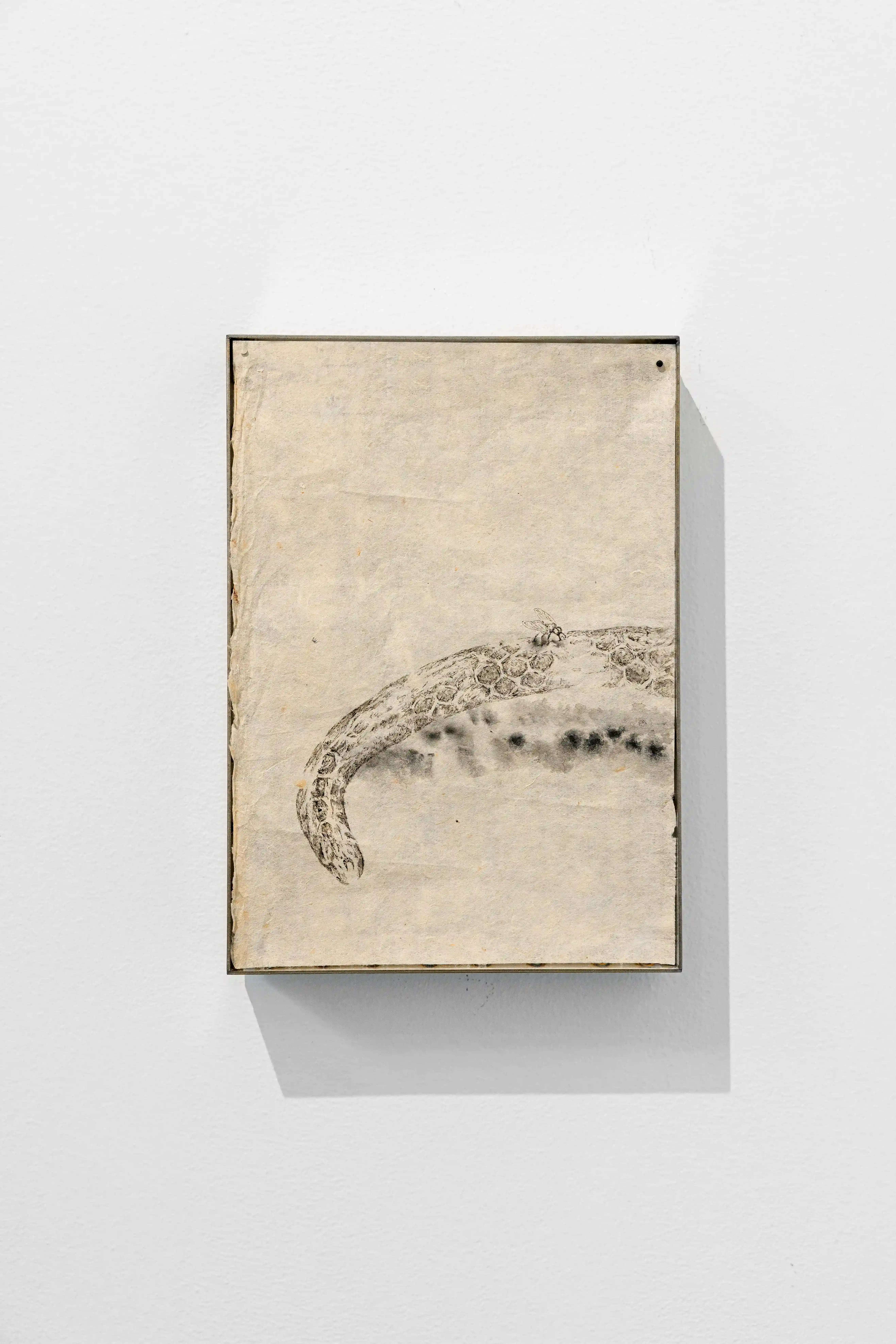
La seconde salle, située plus haut, prolonge cette narration croisée à travers la figure du serpent. Trois dessins à l’encre se déploient, et dans un angle, deux formes métalliques en miroir se répondent.
Le serpent y devient principe d’altération et de renaissance, double du cheval et métaphore de la transformation du récit. Entre ces deux espaces, un dialogue se tisse : du cheval au serpent, du corps dressé au corps rampant, du mythe au fragment. Le dispositif agit comme une cartographie symbolique, un champ d’énergies où le regard circule entre ce qui persiste, ce qui s’efface et ce qui se transforme.
En rendant visibles des formes et des présences reléguées aux marges du récit, Anh Mã et la morsure du serpent propose un déplacement du sensible : un espace où ce qui était muet ou invisible trouve une nouvelle possibilité d’être perçu, d’être entendu. À travers ce cycle, le dessin se redéfinit comme une forme de pensée, une manière de faire apparaître le mythe non comme une illusion, mais comme une autre modalité du vrai.
Some stories hide within the folds of History. They survive as fragments in the memory of a few, then vanish with them into the inexorable drift of time. Everything eventually fades along the line. This project originates from one such interstitial story.
Mohamed Ben Aomar Larach1, a Moroccan trade unionist emerging from anticolonial circles, travelled to Vietnam in the late 1940s as part of transnational solidarities among liberation movements. He was welcomed by the Viet Minh, where he worked to rally North African soldiers conscripted by the French colonial army, before eventually becoming a general. It is said that Ho Chi Minh gave him the name Anh Mã, meaning “Elder Brother Horse”. A name both fraternal and totemic, where human and animal meet in a single figure of passage.
The existence of Anh Mã appears only in fragments for those who seek it out: a few oral accounts, scattered memories, and a book by Abdallah Saaf, who patiently reconstructed, over years of research, the singular trajectory of Mohamed Ben Aomar Larach. This investigative work has nourished my own exploration, opening a path toward a world of images and symbols.
By approaching this trajectory as an interstitial space between memory and erasure, Anh Mã and the Serpent’s Bite reflects on the ways fiction can act as a site of reappearance, where history and imagination intertwine to restore presence to what has been effaced. The forms produced in the exhibition become the site of mythogenesis in action: the visible emergence of a myth in formation, where matter, drawing, and symbol reactivate a buried memory.
From this figure, I sought to unfold a narrative built on correspondences and echoes. The horse, bearer of the name and of the myth, serves as the matrix. It embodies forces of movement, crossing, and the sacred. In the spiritual and mythic narratives of both Vietnam and Morocco, the horse appears as a transversal archetype: a liminal being, a messenger between the living and the spirits, bearer of breath and passage. In Vietnam, Bạch Mã, the White Horse guardian of Thăng Long, reveals the sacred site; in Morocco, it finds resonance in the figure of the Bouraq, a luminous hybrid creature symbolizing the journey between worlds.
Through these resonances, Anh Mã becomes charged with an expanded symbolic power : that of a body of passage, traversed by memory, belief, and transformation.
In contrast, the serpent crawls, sheds, dies; it acts as a principle of alteration and metamorphosis. If the horse carries memory, the serpent introduces the movement of becoming. Together, they embody two temporalities of myth: momentum and metamorphosis, revelation and transfiguration. The serpent’s bite opens a fissure in the horse’s body, a passage from man to horse, from history to myth.
This tension finds its translation in the materiality of the work. Drawing becomes a field of exploration, a mode of approaching what escapes historical language. I work with Dó2 and Xuan3 paper, whose fibrous fragility makes the time of the gesture visible; I set ink and metal, suspension and weight, transparency and opacity in dialogue. Each material holds its own memory: paper carries that of the plant and of breath; metal that of structure and resistance. Between them unfolds an unstable equilibrium, a space where gravity is negotiated. Drawing is no longer mere representation: it becomes a mode of thought, a method of inquiry giving form to the invisible, a way of shaping what remains hollow, between appearance and disappearance.
The exhibition presented at VAC unfolds across two distinct yet interconnected spaces. In the first room, twelve cut-metal forms and seven floating ink drawings create a symbolic constellation. At the centre, a metal-crowned horse faces two inverted hands, while twin serpents seem to rise toward it. Beneath this scene, two gates: one inspired by the Morocco Gate built in Ba Vì in the 1950s by Moroccan soldiers who joined the Viet Minh, and the other by the Vietnam Gate, constructed decades later in Douar Sfari near Kénitra by families descended from these mixed unions. Facing one another like twin thresholds, these architectures, separated by time yet joined by memory, extend through matter the movement of bodies, histories, and belongings. Each is accompanied by an engraved poem (in Vietnamese and in French). Stepping back, the composition reveals the silhouette of a serpent, mouth open an apparition within the apparition. On the floor, a frieze of aluminium horses links the different elements, accompanied by a series of seven drawings on paper.
The second room, located above, continues this intertwined narrative through the figure of the serpent. Three ink drawings unfold there, and in one corner, two mirrored metal forms face each other. The serpent becomes a principle of alteration and rebirth, a double of the horse and a metaphor for the transformation of the tale. Between the two spaces, a dialogue emerges: from horse to serpent, from upright body to crawling body, from myth to fragment. The installation acts as a symbolic cartography, a field of energies where the gaze moves between what persists, what fades, and what transforms.
By making visible forms and presences relegated to the margins of narrative, Anh Mã and the Serpent’s Bite proposes a shift in sensibility: a space where what was silent or unseen finds a new possibility of being perceived, of being heard. Through this cycle, drawing redefines itself as a form of thought, a way of making myth appear, not as illusion, but as another modality of the true.
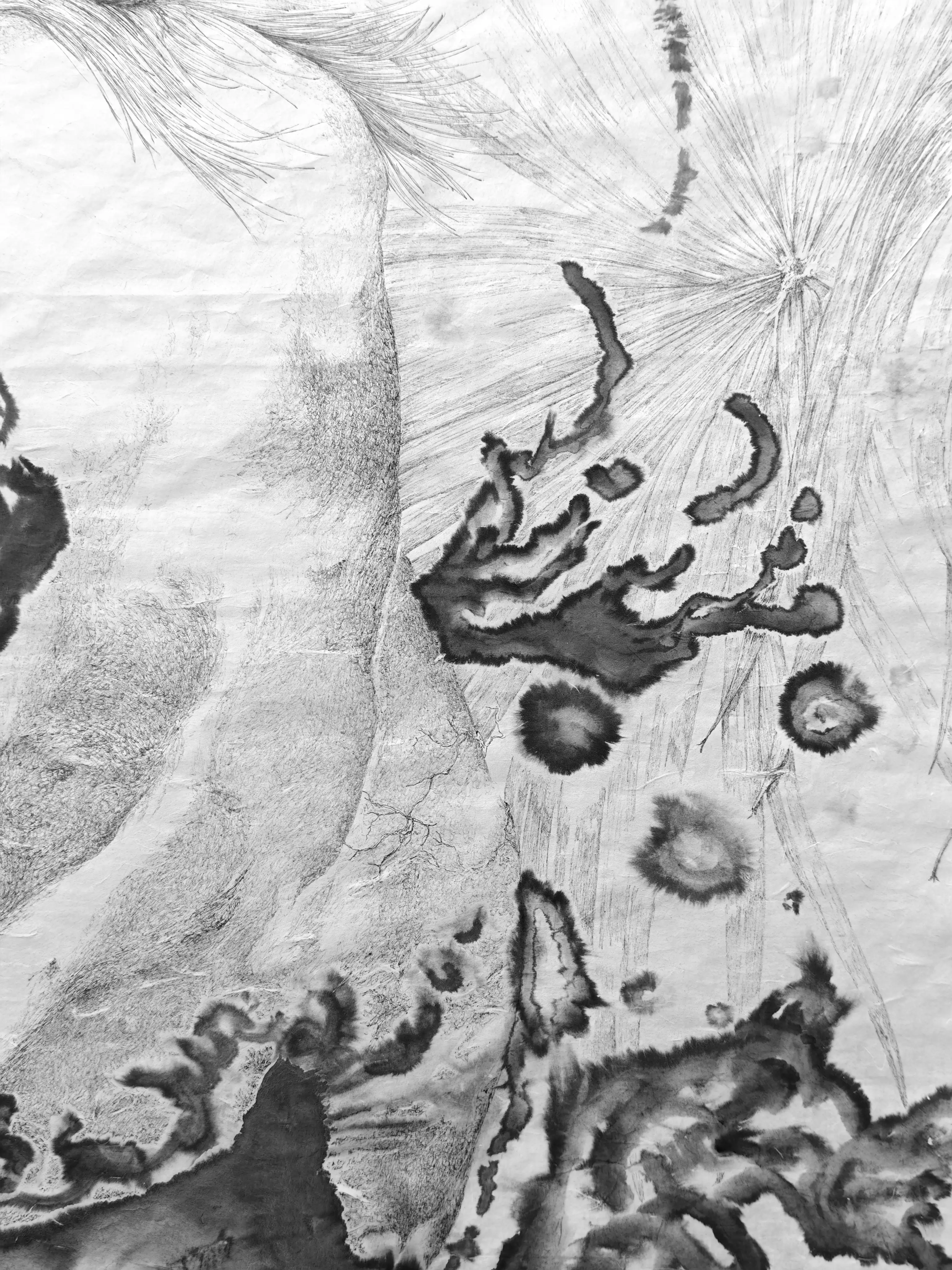
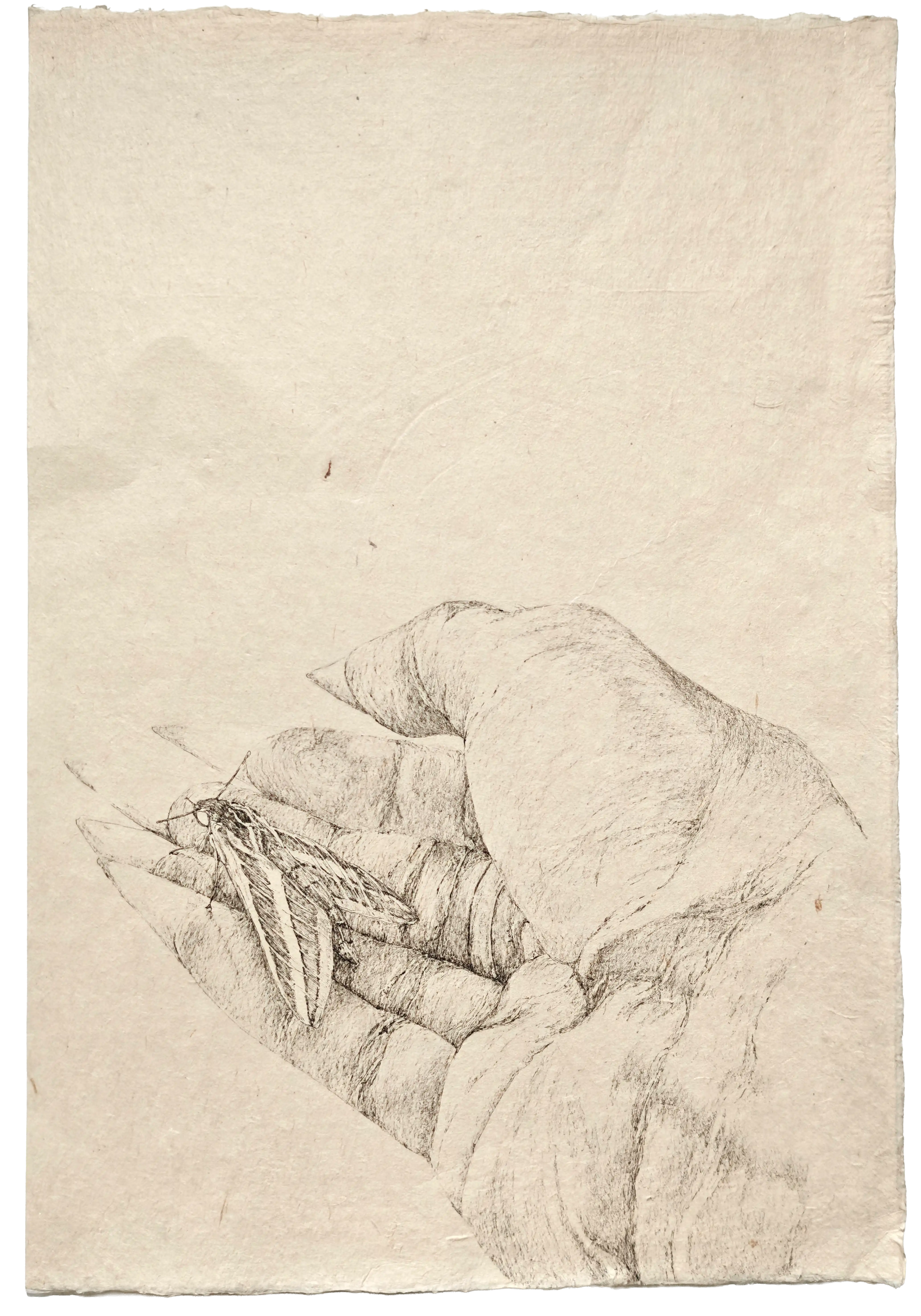
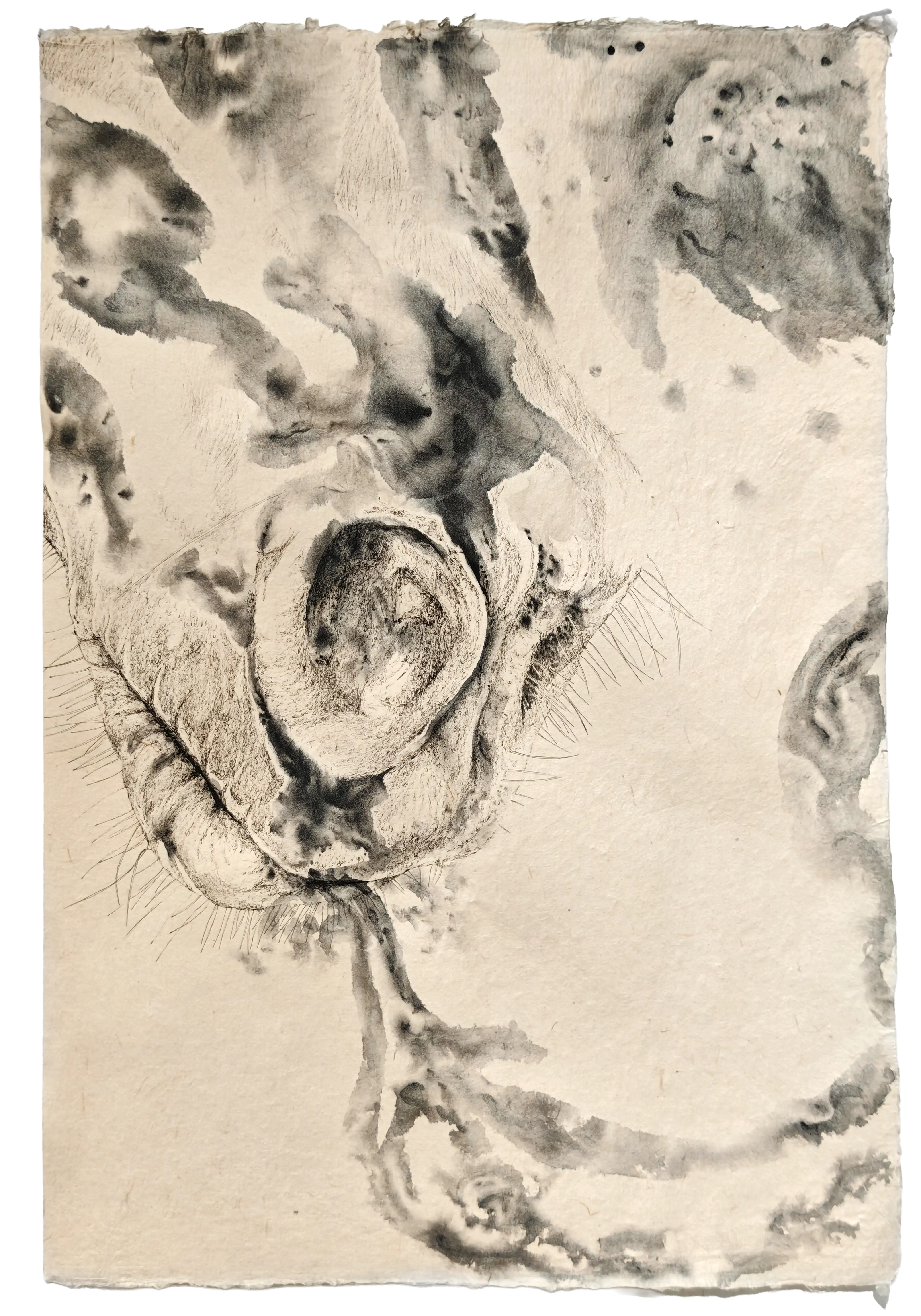
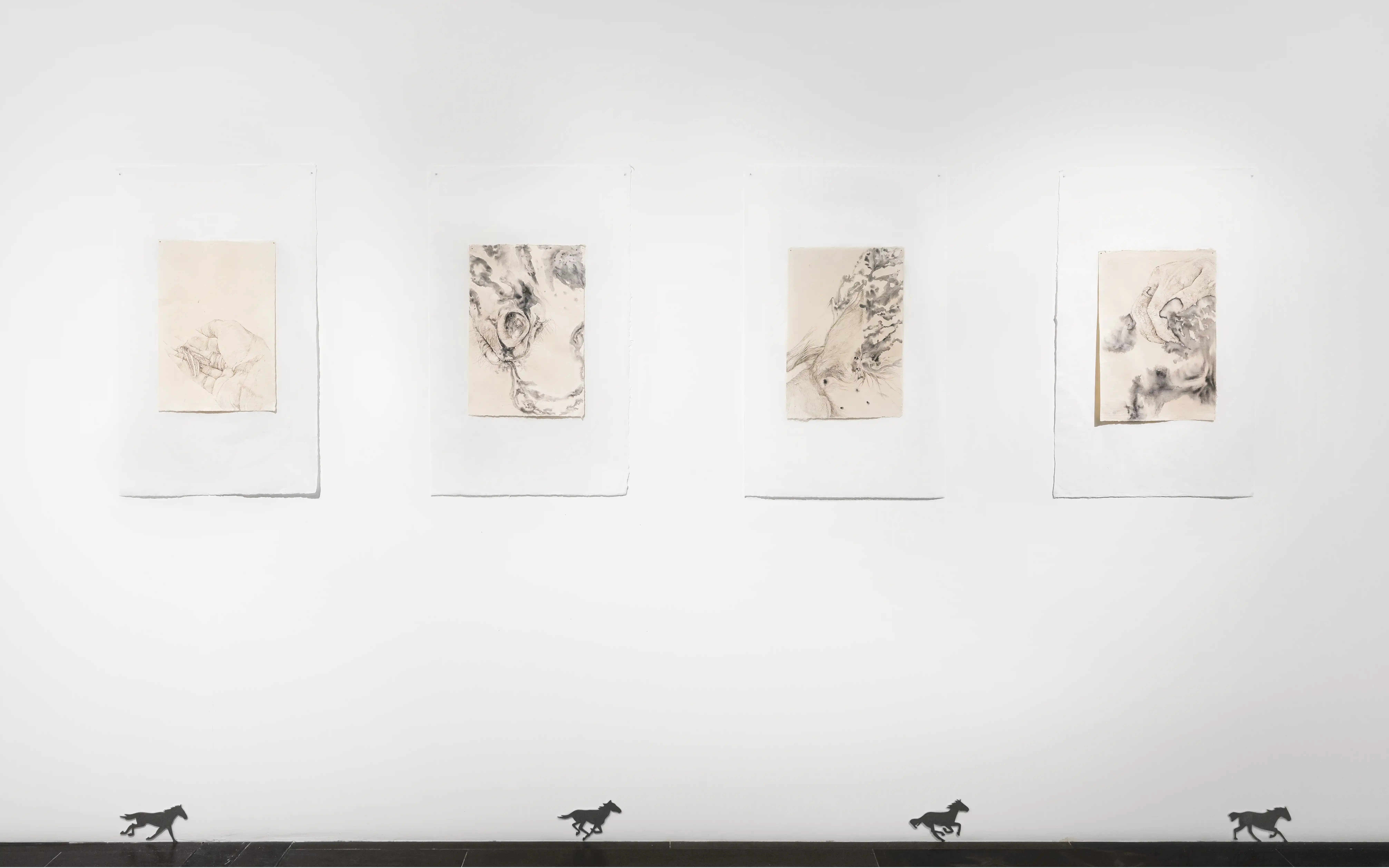
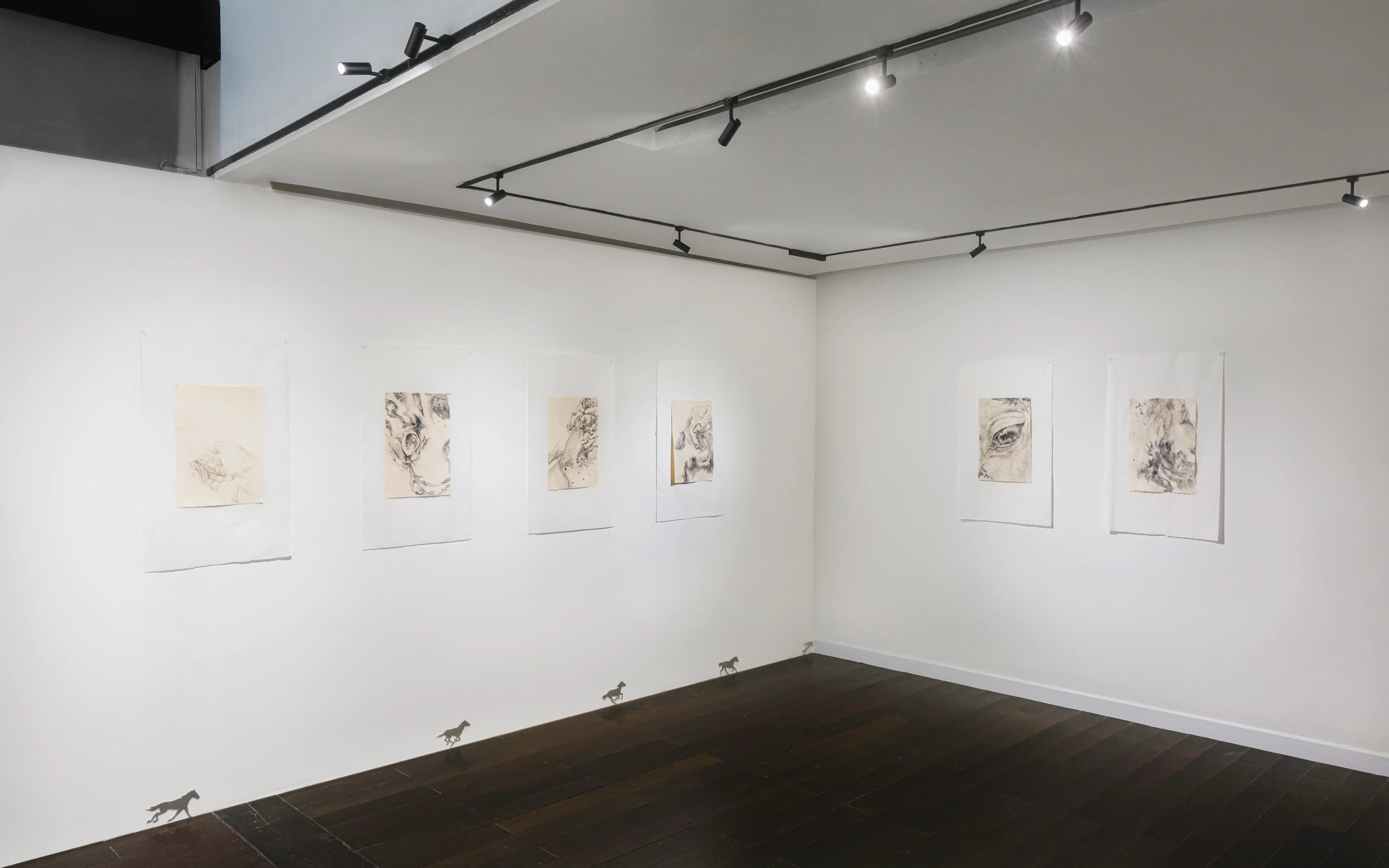
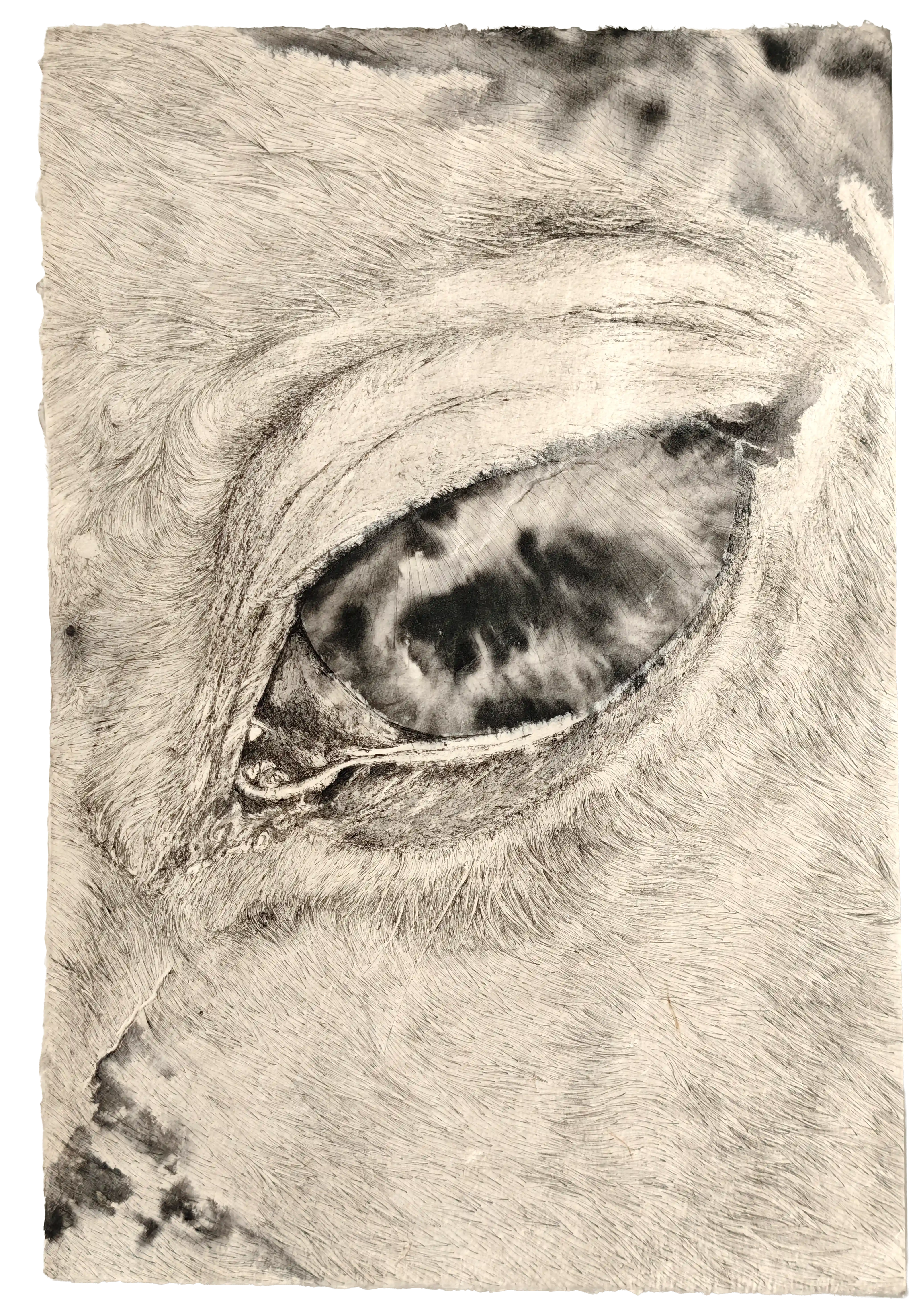
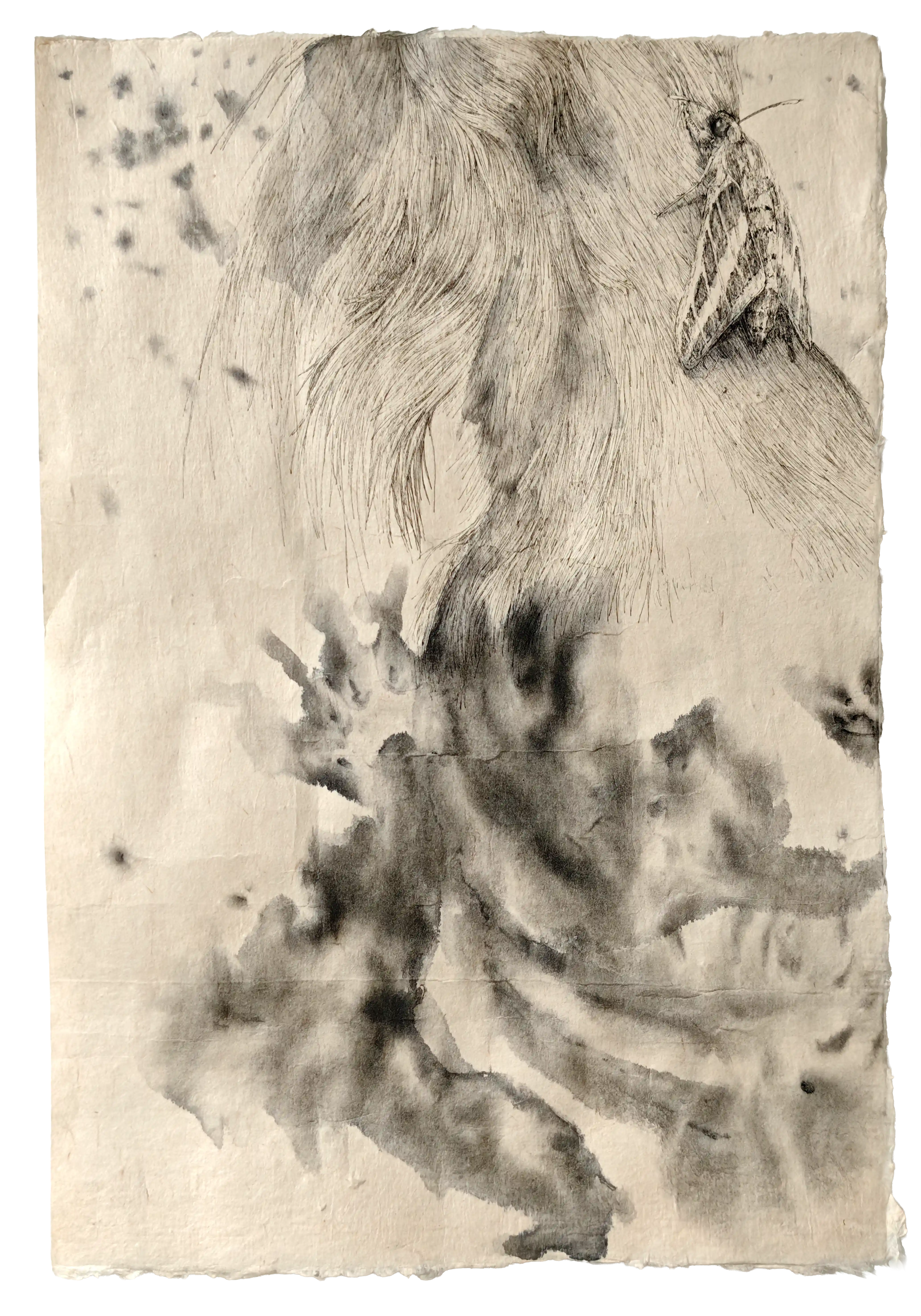
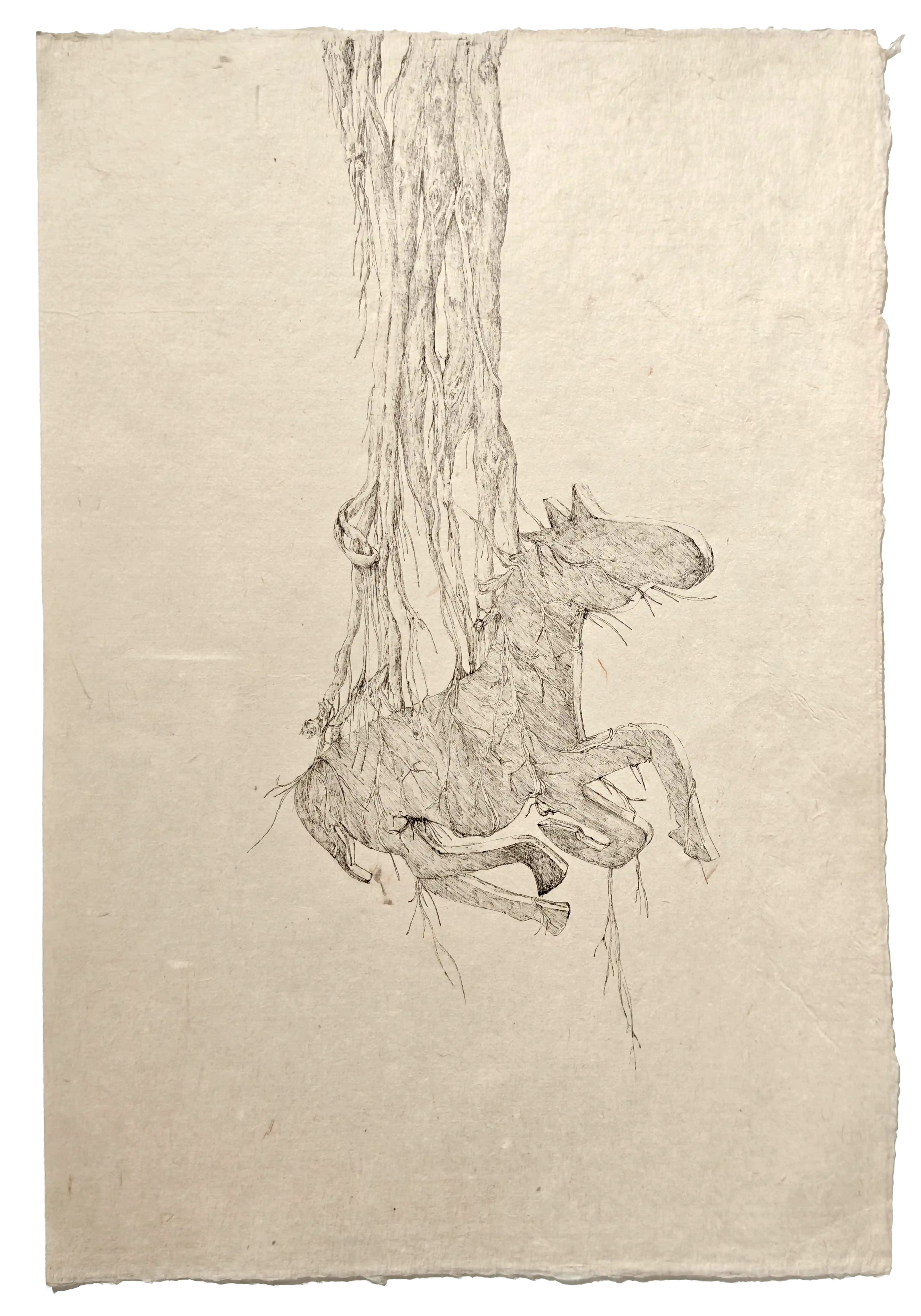
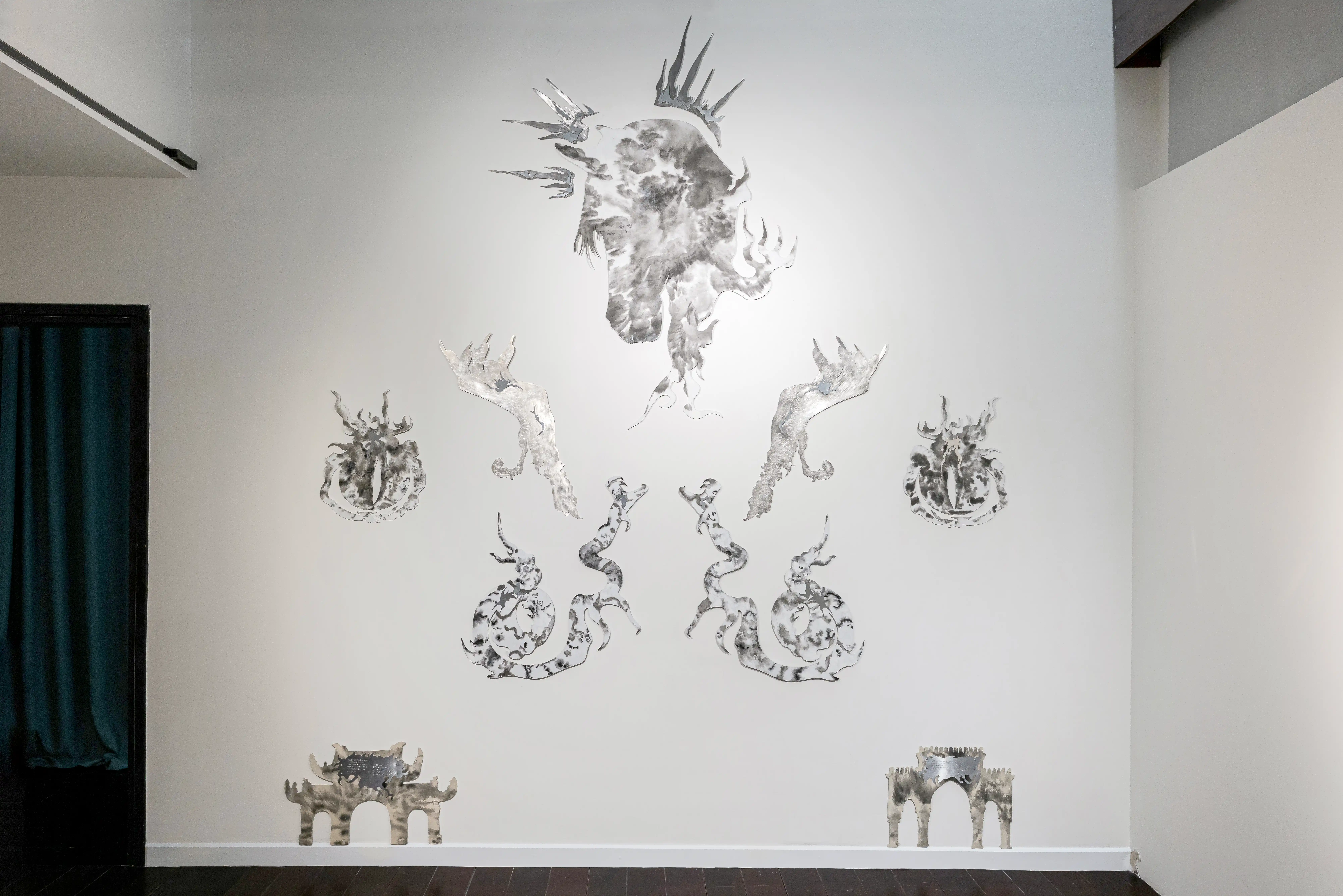
vue d'exposition
formes en fer, encre et eau sur papier Dó et Xuan
metal shape, ink and water on Dó and Xuan paper
vue d'exposition
16 dessins
dessin mural
encre et eau
exhibition view
6 drawings
fresco
water and ink
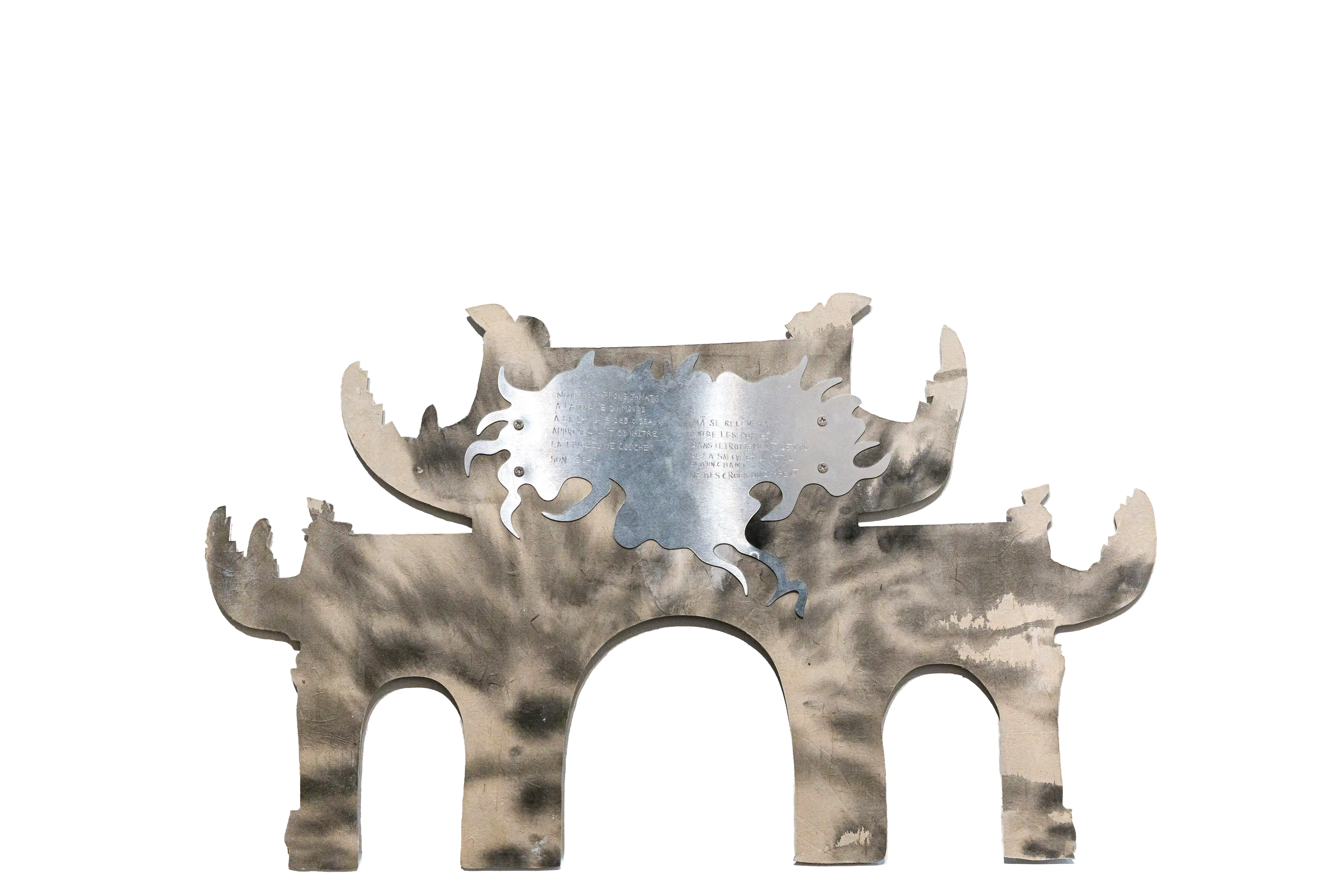
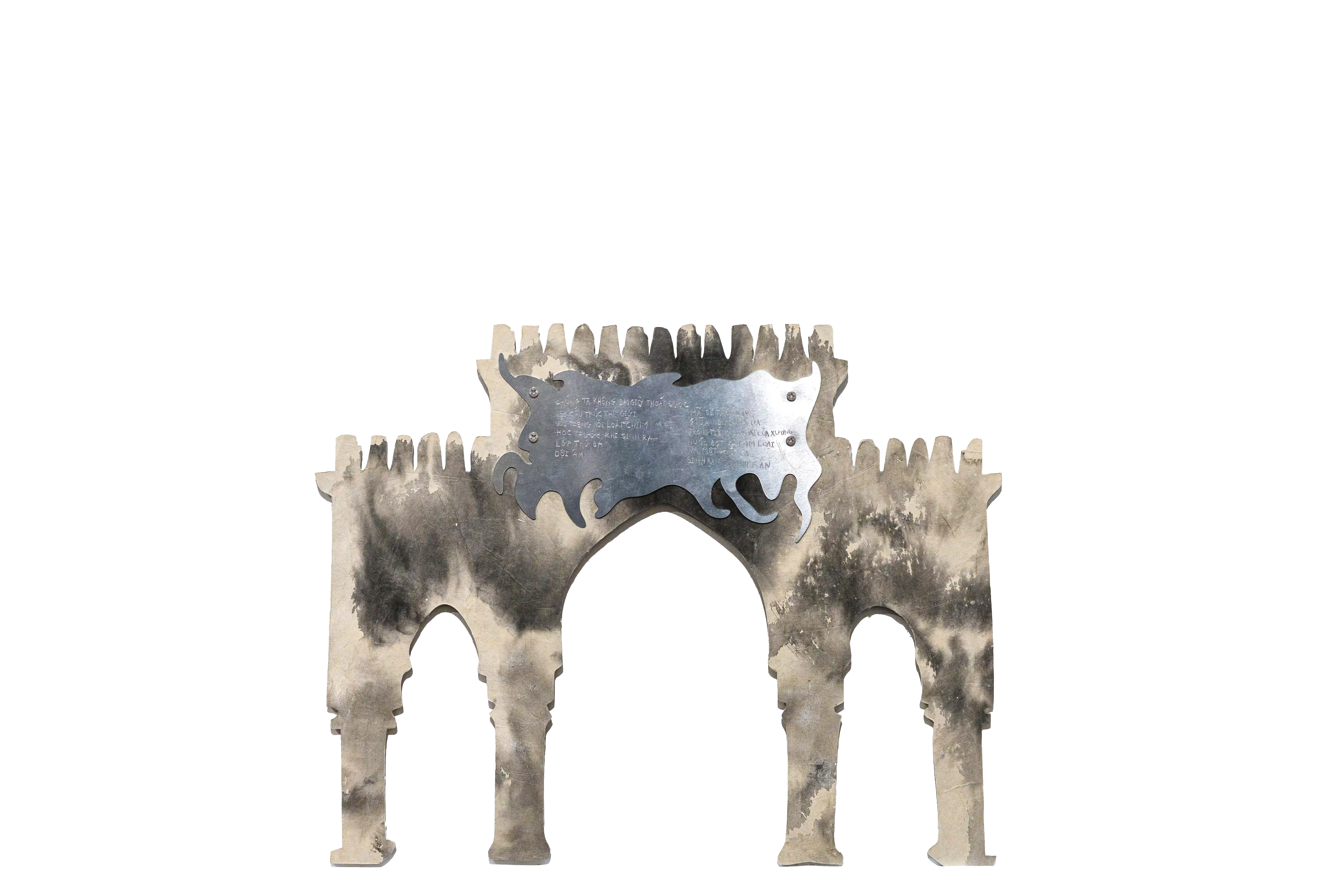
vue d'exposition
poème gravé sur forme en aluminium,
encre et eau sur papier Dó
engrraved poem on aluminium shape,
ink and water on Dó paper
vue d'exposition
16 dessins
dessin mural
encre et eau
exhibition view
6 drawings
fresco
water and ink
nous n’échappons jamais
à la trame du monde
à la langue des oiseaux
apprise avant de naître
la troisième couche
son écho
le cheval se relèvera
entre les portes
dans le frottement des os
de la salive et du métal
et d’un chant
né des crocs du serpent
chúng ta không bao giờ thoát được
với cấu trúc thế giới
với tiếng nói loài chim
học trước khi sinh ra
lớp thứ ba
dội âm
Mã sẽ trỗi dậy
giữa ngưỡng cửa
trong tiếng cọ xát của xương
nước bọt và kim loại
và một khúc ca
sinh ra từ nanh rắn
we never escape
the weave of the world
the language of birds
learned before birth
the third layer
its echo
Mã will rise again
between the gates
in the friction of bones
of saliva and metal
and of a song
born from the serpent’s fangs
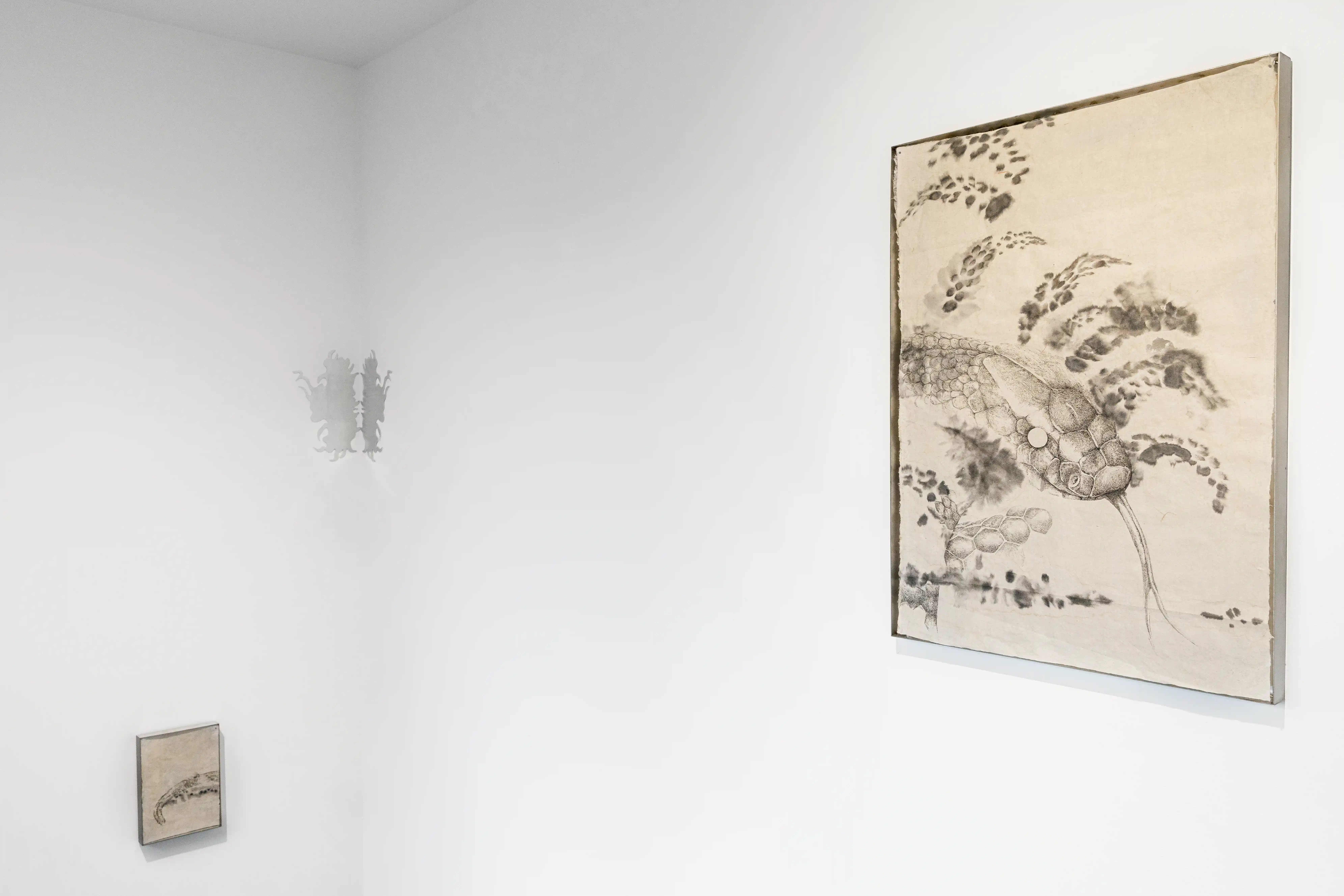
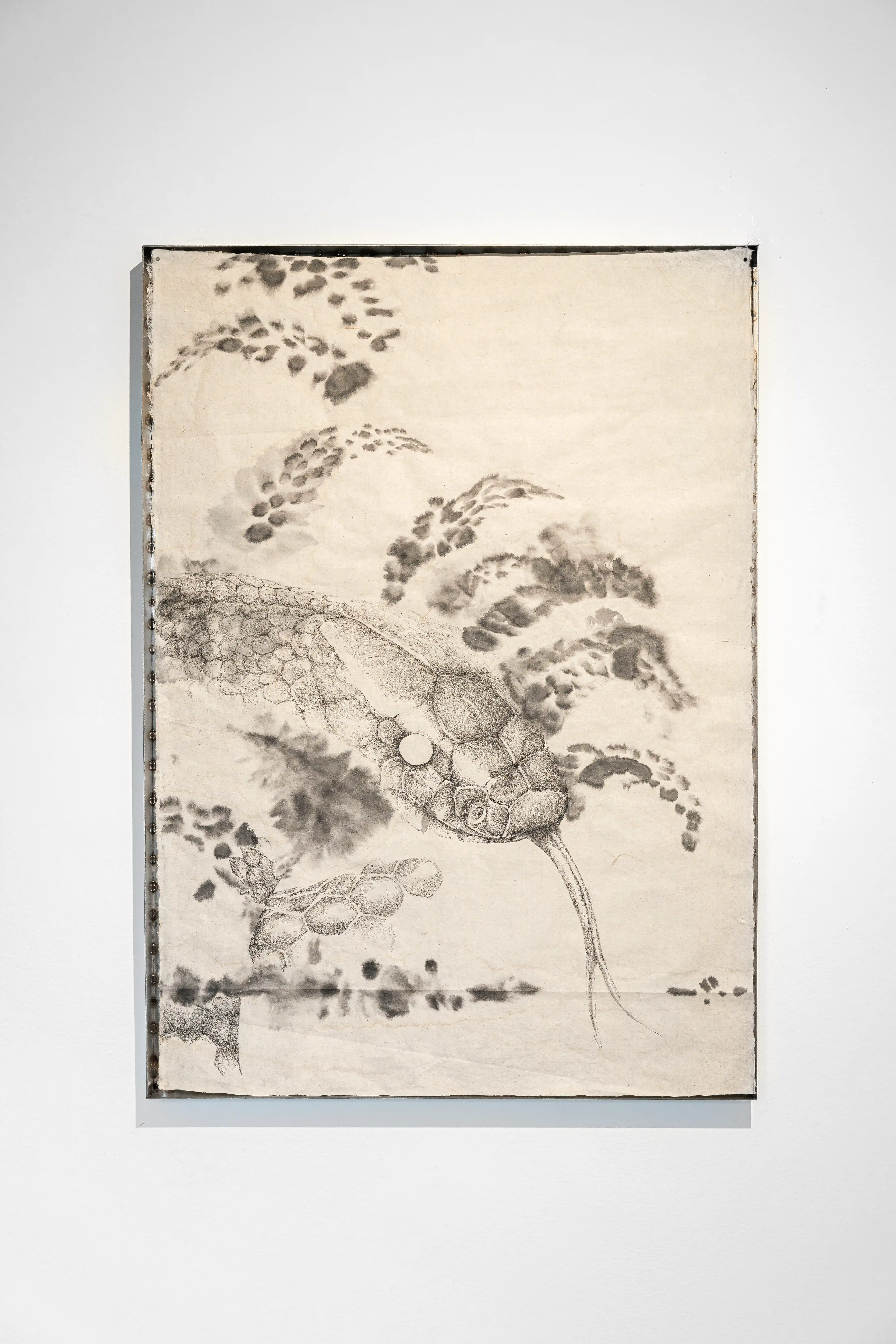
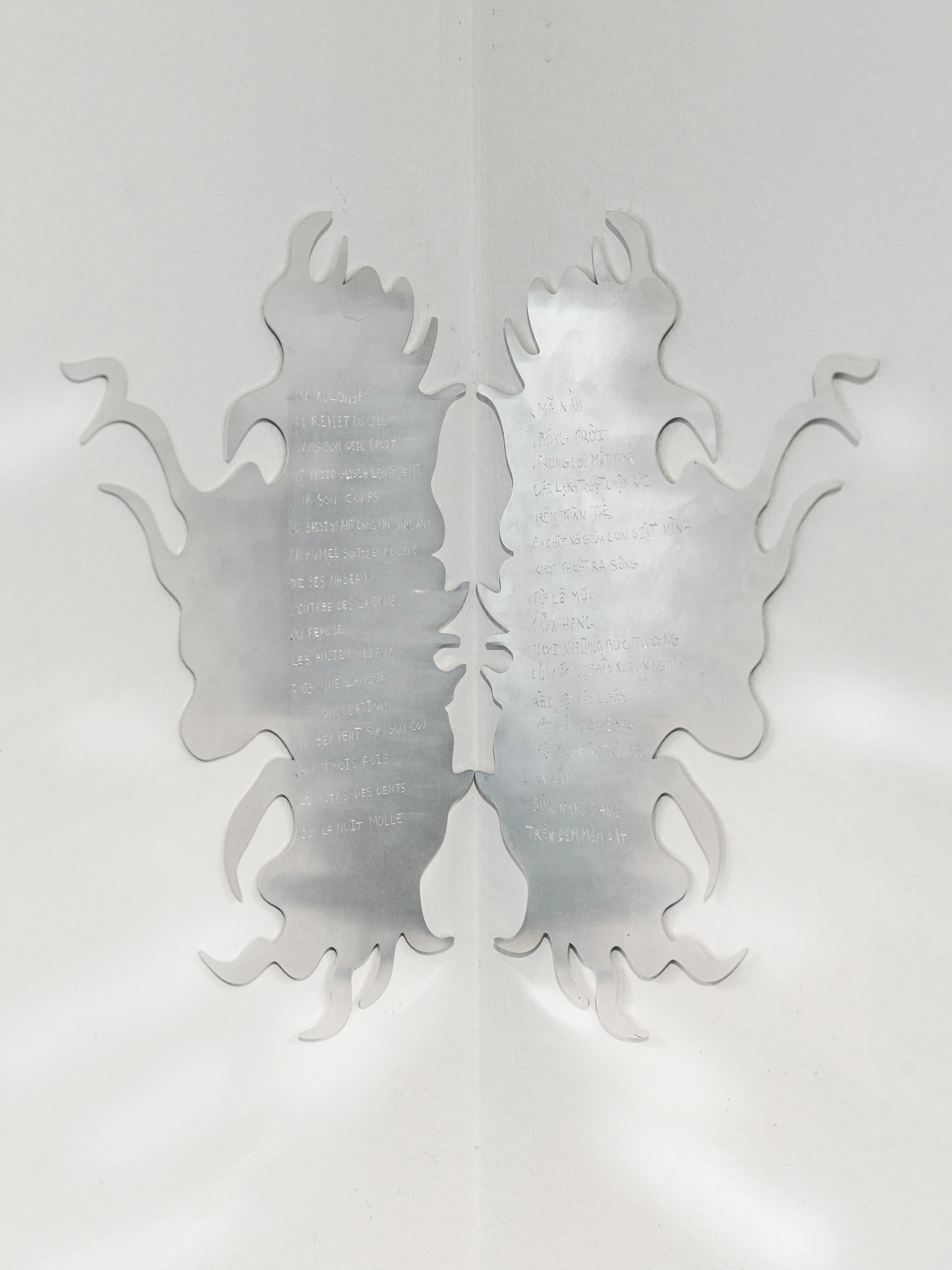
Mã allongé
le reflet du ciel
dans son oeil droit
le froid glissa lentement
sur son corps
le saisissant dans un sursaut
la fumée sortie en rivière
de ses naseaux
l’entrée des cavernes
où repose
les anciens dieux
puis une langue
une ondulation
un serpent sur son cou
par trois fois
le poids des dents
sur la nuit molle
Mã nằm
bóng trời
trong con mắt phải
cái lạnh trượt chậm rãi
trên thân thể
ôm chặt nó giữa cơn giật mình
khói thoát ra thành sông
từ lỗ mũi
cửa hang
nơi những bức tượng
của các vị thần xưa an nghỉ
rồi một cái lưỡi
một làn gợn sóng
một con rắn trên cổ
ba lần
sức nặng răng
trên đêm mềm oặt
Mã lying down
the reflection of the sky
in its right eye
the cold slid slowly
over its body
gripping it in a start
the smoke flowed like a river
from its nostrils
the entrance to the caverns
where
the ancient gods rest
then a tongue
an undulation
a serpent on its neck
three times
the weight of the teeth
on the limp night
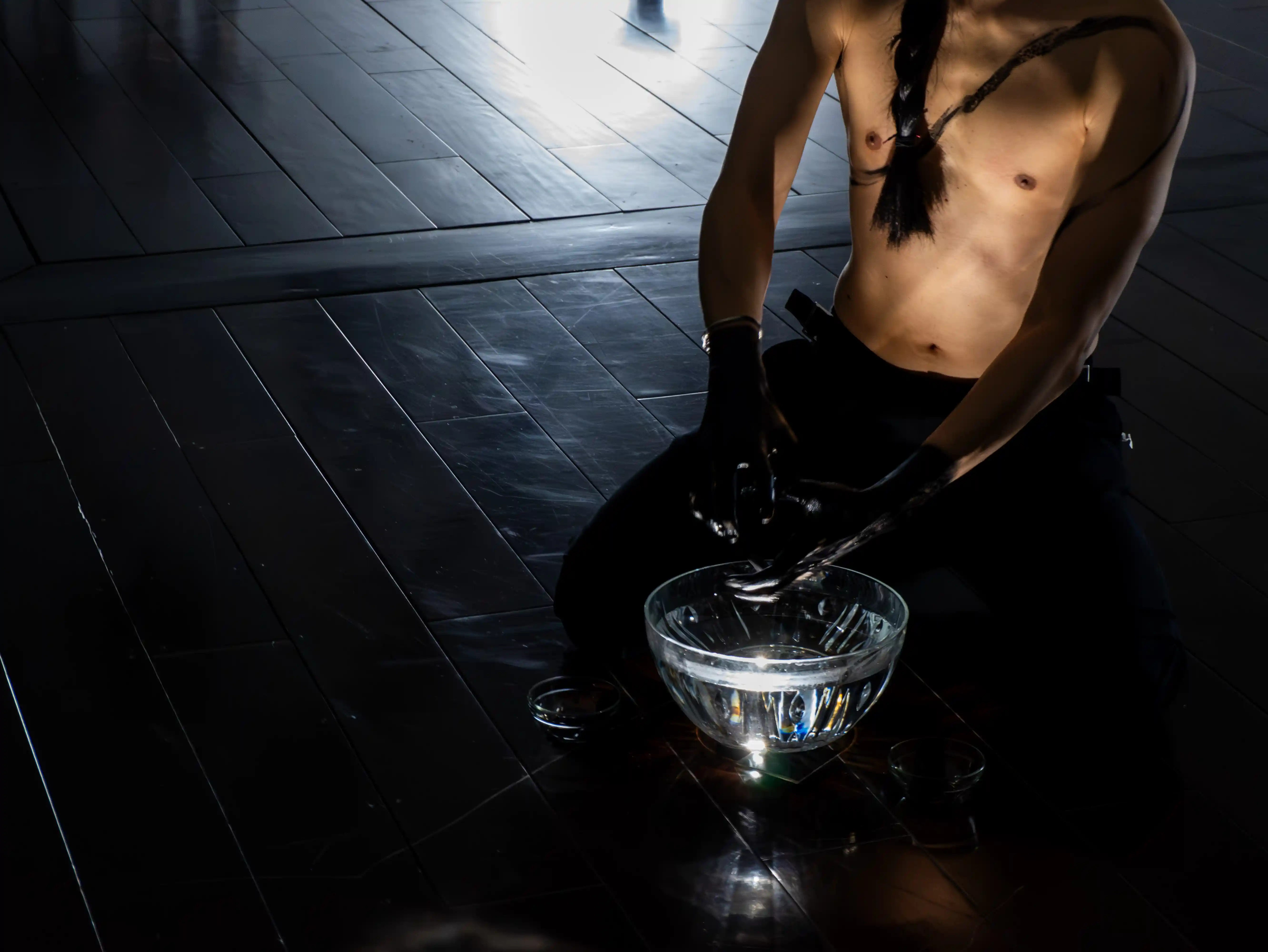
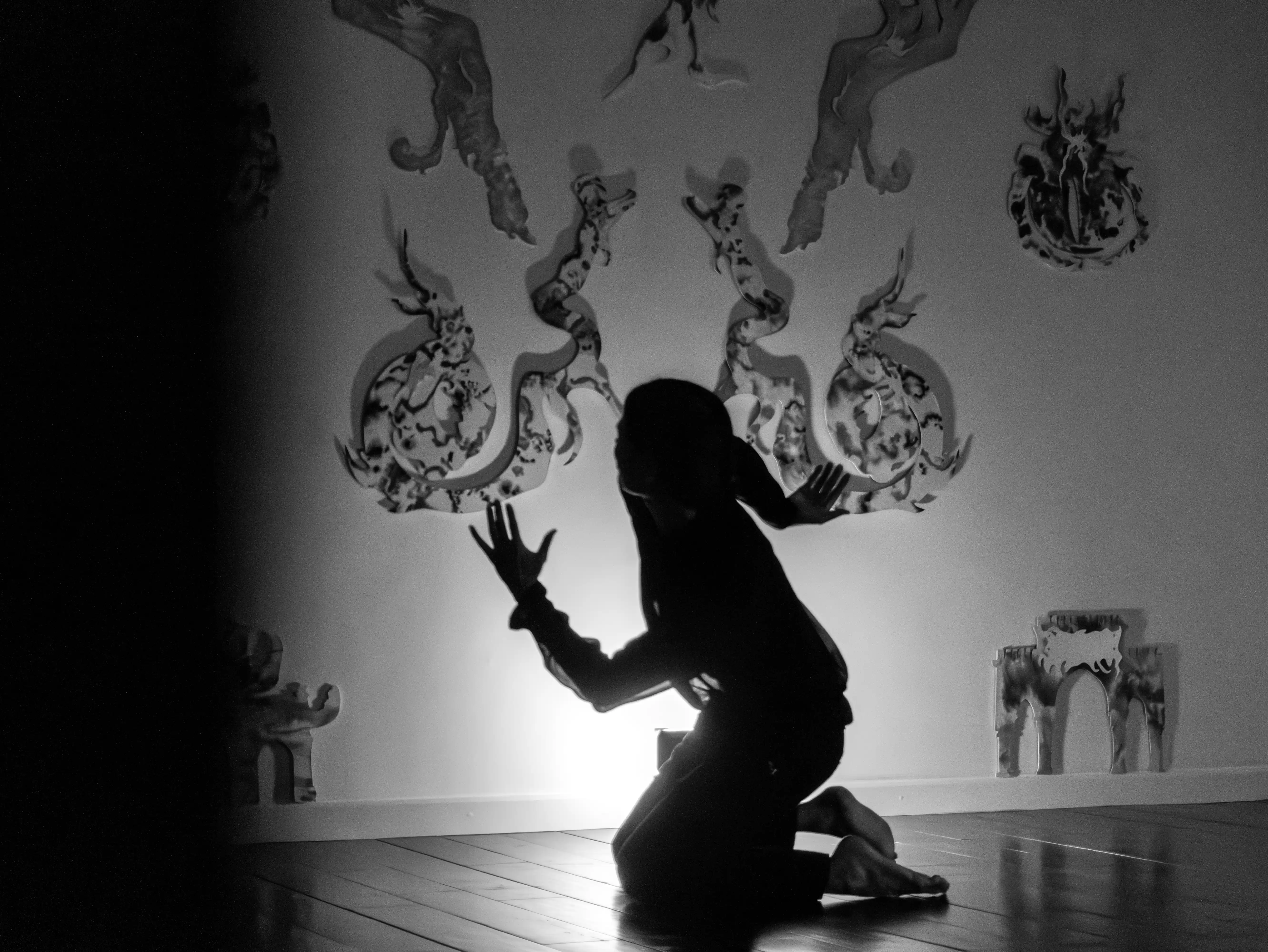
À l’issue de l’open studio, une performance a été conçue en collaboration avec le chorégraphe Sébastien Ly, mêlant danse, engagement corporel et récitation de textes issus du projet Anh Mã et la morsure du Serpent.
Cette intervention ne constitue ni une illustration des œuvres exposées ni une extension narrative, mais plutôt une activation sensible du champ de recherche ouvert par l’installation.
Par le mouvement, le souffle et la voix, la performance engage le corps comme un lieu de passage, entre image et geste, entre texte et matière. Elle déplace le dessin hors de la surface pour l’inscrire dans une temporalité incarnée, où rythme, tension et répétition deviennent des modes de pensée à part entière.
Le corps du performeur agit ainsi comme une surface transitoire, traversée par les figures du cheval et du serpent, par une mémoire fragmentée et par des récits en formation.
Conçue comme une forme autonome, cette performance constitue également une étape de recherche au sein du projet Anh Mã : un espace expérimental où le potentiel performatif de l’œuvre est exploré, anticipant de futurs développements vers des formes hybrides combinant installation, texte, mouvement et voix.
At the conclusion of the open studio, a performance was conceived in collaboration with choreographer Sébastien Ly, combining dance, bodily engagement, and the recitation of texts drawn from the project Anh Mã and the Serpent’s Bite.
This intervention is neither an illustration of the works on display nor a narrative extension, but rather a sensory activation of the research field opened by the installation.
Through movement, breath, and voice, the performance engages the body as a site of passage, between image and gesture, between text and material. It displaces drawing from the surface and inscribes it within an embodied temporality, where rhythm, tension, and repetition become modes of thinking in their own right.
The performer’s body thus acts as a transitional surface, traversed by the figures of the horse and the serpent, by fragmented memory, and by narratives in formation.
Conceived as an autonomous form, this performance also constitutes a research stage within the Anh Mã project: an experimental space in which the performative potential of the work is explored, anticipating future developments toward hybrid forms combining installation, text, movement, and voice.